I spent three hours last Tuesday tracing a phantom power draw in my basement that was costing me forty dollars a month for absolutely no reason. It turns out, a legacy server and an old dehumidifier were conspiring against my wallet. Most people start their smart home journey with a few colorful lightbulbs or a voice assistant that tells them the weather, but if you are serious about infrastructure, you eventually look at your circuit breaker and realize it is a relic of the twentieth century. That is where the mission for granular control begins, moving past the novelty of voice-activated lamps and into the territory of actual home management.
High-end automation is not about having more gadgets; it is about having more data and more reliability. When you reach the point where a simple Wi-Fi plug is not enough—either because of signal interference or because you need to switch heavy loads safely—you move to the Pro line. I wanted something that did not just sit between the outlet and the appliance, but lived inside the wall, handling the heavy lifting without breaking a sweat.
| Feature | Shelly Pro 4PM | Standard Smart Plug | Basic Smart Relay |
|---|---|---|---|
| Channels | 4 Independent Channels | 1 Channel | 1 Channel |
| Connection | Wi-Fi, LAN, Bluetooth | Wi-Fi Only | Wi-Fi Only |
| Mounting | DIN Rail (Breaker Box) | Wall Outlet | In-Wall Box |
| Power Metering | Yes (Per Channel) | Sometimes | Rarely |
| Max Load | 40A Total (16A per channel) | 10-15A | 10A |
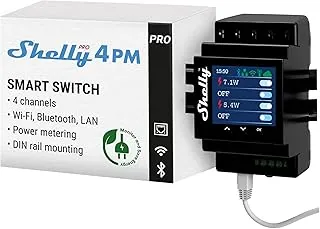
Shelly Pro 4PM | Wi-Fi & LAN, 4-Channel Smart Relay with Power Metering
Is the Shelly Pro 4PM Worth It?
Wiring a relay directly into your electrical panel feels like a rite of passage for the dedicated smart home enthusiast, and the Shelly Pro 4PM makes that transition feel remarkably professional. The first thing you notice is the build quality; it is designed to snap onto a standard DIN rail, fitting perfectly alongside your existing breakers. Unlike the cheaper consumer-grade relays that feel like hollow plastic, this unit has some heft and a crisp 1.8-inch color screen that gives you real-time feedback on voltage and consumption before you even open the app.
Connectivity is where this device separates the amateurs from the pros. While most smart devices rely on a prayer and a strong Wi-Fi signal, the Pro 4PM includes an Ethernet port. If you are building a system that controls essential appliances, you want the stability of a hardwired LAN connection. During my testing, the latency was nonexistent—commands from my Home Assistant dashboard were executed instantaneously. The internal power meter is incredibly precise, allowing you to set scripts that trigger actions based on consumption, like turning off a secondary heater if the total load on the circuit exceeds a certain threshold.
Pros:
- Four independent 16A channels allow for controlling multiple rooms or high-draw appliances from one spot.
- Ethernet connectivity ensures your smart home stays smart even when the Wi-Fi is acting up.
- Integrated power metering provides granular data to help hunt down energy vampires.
- The on-device display is incredibly useful for troubleshooting without a phone in hand.
Cons:
- Requires professional installation or a very high comfort level with mains electricity.
- The unit is wider than standard breakers, so ensure you have enough space on your DIN rail.
The verdict is simple: if you are tired of the instability of plug-and-play smart home gear and want a solution that feels like a permanent part of your house, the Shelly Pro 4PM is the gold standard. It transforms a dumb electrical panel into an intelligent energy management hub that provides both peace of mind and genuine utility. While the price point is higher than a handful of smart plugs, the reliability and data density it provides are well worth the investment for any serious automation setup.